For as long as USA Baseball has fielded teams in international competition, there have been heroes rising to the occasion in the biggest games. Legendary moments like Ben Sheets tossing a complete-game, four-hit shutout in the gold medal game at the 2000 Olympics loom large in fans’ memories. Or, for younger fans, Adam Jones’s game-saving home-run robbery against Manny Machado and the Dominican Republic in the 2017 World Baseball Classic final stands out.
Twenty years ago in Havana, Cuba, in an event that was neither televised nationally nor memorialized in baseball history, one player donning the stars and stripes delivered the clutchest of performances in the biggest of games. He was only a minor league baseball player at the time, and he was never known as a home run hitter. But when Michael Bourn belted two decisive homers in the gold medal game of the 2006 Olympic Qualifiers to stun Cuba, he undoubtedly provided one of the greatest moments in Team USA history.
“I had a pretty good game,” says Bourn with a laugh, during a recent interview. “That was a monumental moment for us. I wouldn’t give that experience up for anything.”
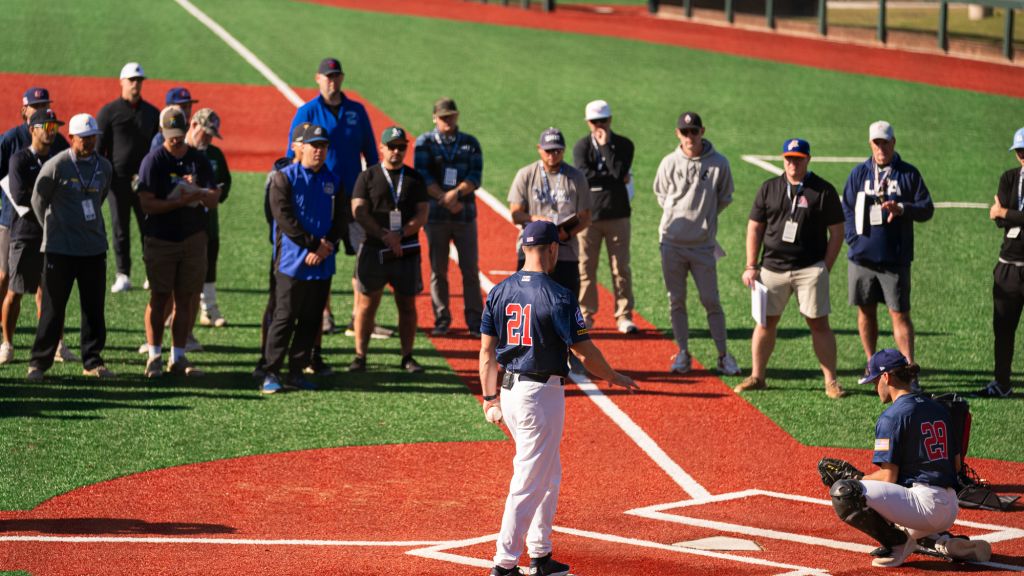
It’s that sense of pride and joy that the former MLB All-Star and Gold Glover hopes to impart on the young athletes at the 16U/17U National Team Development Program, which is taking place this week in Cary, North Carolina. The event, which features 88 players competing in workouts, skill development sessions, and round-robin scrimmages, will mark Bourn’s coaching debut with USA Baseball.
“It's a blessing to be able to participate in this kind of event with the young talent coming along,” says Bourn. “I know what they are feeling, being around the best players in their class and trying to make the team. I’m very excited to watch the challenge and how they perform.”

Bourn is certainly no stranger to the hectic nature of the national team process. His experience with the Professional National Team in August of 2006 came during the middle of his minor league season with the Philadelphia Phillies organization when he was trying to reach the big-league level. To this day, Bourn recalls the chaotic sequence of events that took place while he was training with Team USA in Miami before the trip to Cuba:
“One of our coaches was a guy named Roly [de Armas]. He was with the Phillies, and he was also a coach of Team USA. He came to me and said, ‘Hey, you might be leaving and going to the big league team.’ I'm like, ‘What?!’”
A few days later Bourn was told to pack his bags and fly to Chicago to join the Phillies. By the time he arrived, however, the team had already traded for a player to fill his role. Then-Phillies manager Charlie Manuel broke the news to Bourn, who then flew back to Miami to rejoin Team USA.
“I was mad that day because it was the big leagues. But I was happy because I did want to play with Team USA. I really wanted that experience. For some odd reason, it was just sticking to me.”
The team, which included a handful of future MLB All-Stars in Bourn, Billy Butler, and Kurt Suzuki, departed for Cuba a few days later. Legendary skipper Davey Johnson managed the squad, and future major league manager Skip Schumaker made the trip as an outfielder. Needless to say, confidence was high as Team USA flew south with a plane full of young talent.
“The mindset going into that tournament is to win it, of course,” recalls Bourn. “But to be honest with you, I think as a team we thought it was going to be a cakewalk until we got to Cuba.”
The team quickly found out they were in for a dogfight after losing to Venezuela a few games into the tournament. Facing elimination and needing to win out, Bourn says he and his teammates realized they needed to lock in. He recalls a difficult team meeting where the coaches told the players that adjustments needed to be made, including moving Bourn to the bottom of the lineup. He took the change in stride, however, and helped Team USA rattle off three straight wins to reach the title game.
It was there that the stars and stripes faced Cuba before a crowd of fans supporting the host country in Estadio Latinoamericana.
“In the first inning, I would say there were maybe 7,000 to 8,000 fans there. But at the end of the first inning, the buses pulled up, and you could just see [the Cuban fans] filling the whole stadium. Just going ‘whoo, whoo!’ They came from everywhere, and they were running all around because of the way the stadium was made. They just ran into the stadium, and the stage was set. It was time to go.”
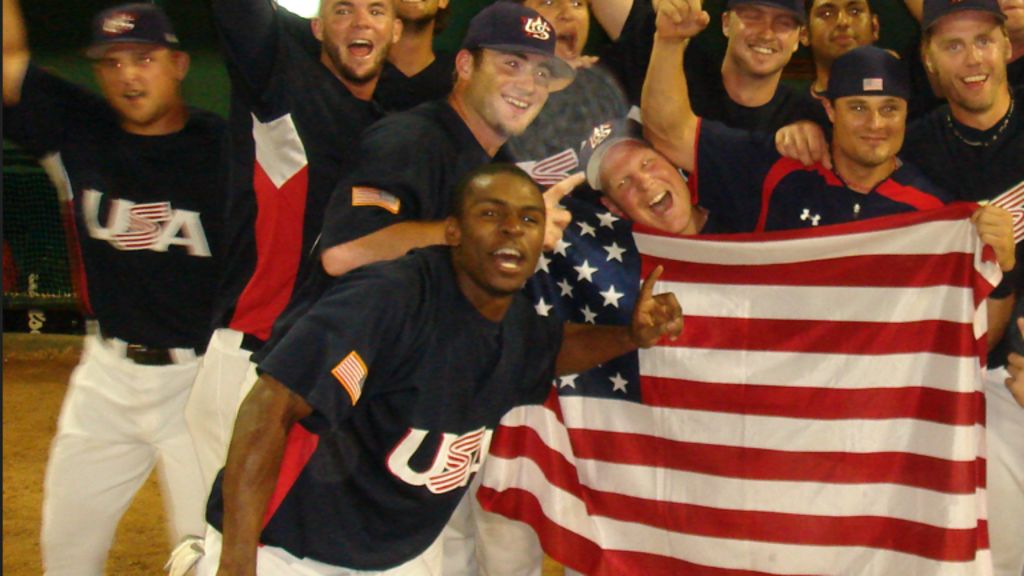
By the time the Cuban crowd piled in, there were around 35,000 attendees by Bourn’s estimate. The back-and-forth game did not disappoint the home crowd, but the result did thanks to Bourn’s heroics. His first homer to right and his second bomb to deep center made all the difference, as the U.S. prevailed against the host country 8-5 to win the gold medal.

“Once we made that last out, we all let it out, man,” he remembers. “That was the best bus ride home I have ever experienced.”
The experience in Cuba marked a crucial point in Bourn’s career, as he got the call up to the Phillies just a few days after winning gold. He spent the remainder of the year playing before packed crowds like the one in Havana as the Phillies battled for a spot in the postseason. Two years later, he got a chance to be a regular starter with his hometown Houston Astros, and the rest was history.
From 2009 to 2012, Bourn was one of the best players in baseball, making All-Star Games with the Astros and Atlanta Braves and winning back-to-back Gold Glove Awards for his work in center field. By the time his career concluded in 2016, Bourn had racked up 1,272 career hits, 361 RBIs, and 341 stolen bases.
Still, Bourn remembers his time with Team USA and the lessons it taught him as a player.
“The kids need to understand the sacrifice that you have to make. When you have that U-S-A on your chest, [opposing teams] are coming after you. They want to beat you. They want to beat you more than anybody else that's out there. And when you're trying to win a gold medal, you have to sacrifice it all.”
Bourn will get a chance to teach these lessons as the manager of one of the four teams that the players at NTDP will be separated into. Throughout the event, he will also be helping the rest of the coaching staff assess and evaluate the players for the 18U National Team. Along the way, he hopes to coach the finer details of the game.
“I want them to understand that you have to be able to do the little things,” says Bourn. “You have to learn how to cut your swing down and not try to always go for the home run.”
It’s an important lesson for players to hear this week at the sixth annual NTDP, and it’s a lesson that perhaps no one is better suited to deliver than Bourn. The 5-foot-11 speedster made a big-league career out of running down fly balls and battling for the next 90 feet at the plate and on the basepaths.
The players on the 2006 Olympic Qualifying Team, however, will always be happy that Michael Bourn had a few home runs up his sleeve.