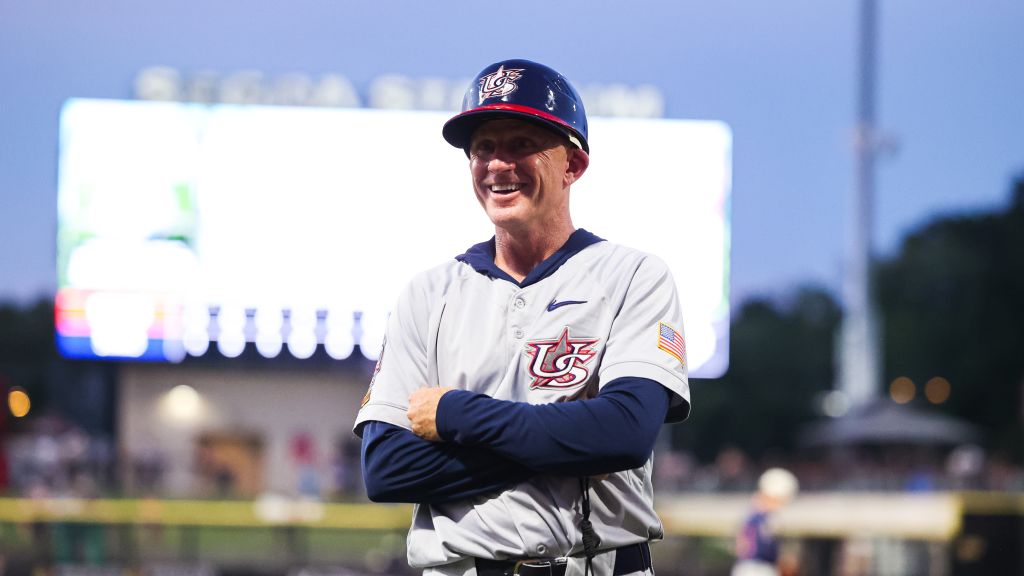
Between the 14 coaches who were at USA Baseball’s 2026 Collegiate National Team Training Camp, there are countless accolades that have been accumulated from their combined 250 years of coaching experience. They hail from every corner of the country, but this week, they assembled in Cary, North Carolina, to guide the next generation of rising stars as they prepare to compete in the inaugural World Collegiate Baseball Championship in Taiwan.
The staff boasts a combined seven World Series rings and 15 international gold medals in addition to their years of experience at the Division I level and in the major leagues as coaches and players. They have a proven track record of success, showing they not only know how to make it to the highest level of competition, but stay there and win as well.
“As you acquire these fundamentals over the years, and you get in conversation with other guys who have done the same, it's a meeting of the minds, and it's fun,” said Mike Scioscia, who served as Senior Advisor at this year’s Training Camp.
With over 50 years of baseball experience as both a player and coach, Scioscia brings a wealth of knowledge in his role, mentoring both the coaches and players. He spent his entire playing career as a Los Angeles Dodger, winning World Series titles in 1981 and 1988 and earning two All-Star selections, before hanging up his cleats in 1992 to become a coach in the organization.
After the 1999 season, Scioscia moved across town to become the manager of the Los Angeles Angels (previously Anaheim Angels), a position he held for 19 years before retiring at the conclusion of the 2018 season. During his tenure, he led the organization to its first and only World Series victory to date in 2002.
Despite his retirement from the majors, Scioscia couldn’t stay away from the baseball world and joined USA Baseball in 2021 as the manager of the Professional National Team, helping the U.S. qualify for the Tokyo 2020 Olympic Games and then finish with a silver medal at the event. His most recent stint with the program was in 2024 when he guided USA Baseball’s Premier12 squad to a bronze-medal finish. With the knowledge of what it takes to be successful at the highest level of baseball from both sides, it's his goal to pass it on and play a role in shaping the next generation.
“We have an understanding of what you want to do at certain ages and what you need to do to eventually become that player that you want to become, and that's what this is all about,” Scioscia said. “I think it's just trying to fill up the kids with confidence that they will acquire through practicing the game properly.”
His goal of instilling confidence in players is one that he achieved with David Eckstein, an assistant coach on the Stripes Team, more than two decades ago. Eckstein had to earn every chance he got, often being overlooked due to his size as he stood at just five-foot-seven. What he lacked in size, he made up for in knowledge of the game.
“Anytime we were on the field and David was playing, he was the smartest guy on the field,” Scioscia said. "He had the best baseball instincts.”
Scioscia once told Eckstein that if he believes in something, in a player, to stand up for them even though they may be overlooked by scouts and to trust his own eyes. After all, David began as a walk-on at the University of Florida, and went on to earn two All-Star selections and win World Series titles with the Angels and St. Louis Cardinals, being named MVP in one of them. It was his relentless pursuit of success that got him there, and it’s his favorite quality to see in the next generation of players.
“In order to play this game, you have to have a passion, you have to have a love, and you have to have a sacrifice and a discipline,” he said. “When I come across a kid that truly understands that, my wife would even tell you, you can't get the smile off my face because I love seeing that drive.”
Eckstein says these are the guys who he enjoys working with the most because they have the desire to make it to the next level and are willing to put in the work to get there. It’s a mindset he knows well because from a young age, Eckstein was motivated by the family rivalry between him and his older brother, Rick.

“I joke I was a major leaguer because my brother had an arm and he actually challenged me when I had to hit,” David said. “I didn't have an arm, so he was never challenged.”
The two played for the Florida Gators and competed for a national title in Omaha together in 1996, and while David went on to the majors, Rick turned to coaching.
After his collegiate career wrapped up on a high note, with the Gators finishing the season ranked third overall and competing in the Men’s College World Series, Rick couldn’t turn down Gator head coach at the time Andy Lopez’s offer of a volunteer assistant position. He had used up his four years of playing eligibility, but still needed a few more credits to graduate so he would be sticking around Gainesville anyway. It was never part of his plan, but accepting the position became one of the best decisions of his life, even though he didn't realize it at the time.
“After my first year, on the way home from the regionals in Miami, we were flying on the team plane, and I told Coach Lopez, ‘I don't think this is for me,’” Rick said.
Lopez wouldn’t accept this answer, telling Rick he was an excellent coach and would be returning for a second season. So he did, and has continued to do so ever since. In addition to his major league and collegiate roles, he’s worked with USA Baseball for over 20 years in various positions. In 2024 and 2025, he managed gold-medal winning 18U squads and this year, he served as the manager of the Stripes Team during Training Camp. With the amount of experience he has, Rick is grateful that he’s been able to use his role to develop the next generation of baseball stars.
“I think that's the advantage that we have when they come to the USA program, we're putting them in front of people that have been there, that have done it, that have learned the lessons they need to learn to get not only past the hurdle of the highest level, but stay at the highest level, and there's a big difference there,” Rick said. “USA Baseball has embraced all the ex-players that have turned to the coaching ranks, and they're influencing across the board at the 18U, college, and professional ranks.”
In order to make a national team, he says that physical talent is only the starting point of what the coaches look for. They look for selflessness and the ability to overcome adversity both on and off the field. Stripes assistant coach Rick Ankiel knows the evaluation process well, having made the 18U National Team twice as a player and coaching during 18U National Team Training Camp in 2024 and 2025 before moving up to the collegiate level this summer.
“[Players have to] understand that for me, for all the big league guys that are here, we've already lived our dream, and we want to see you live your dream,” Ankiel said. “If somebody's trying to give you messaging, take it for what it is, and learn from it, and try to grow your game in that way.”
Ankiel’s major league journey is different from most, making his insight uniquely valuable. A highly touted pitcher coming out of high school, Ankiel was drafted in the second round of the 1997 MLB Draft by the St. Louis Cardinals. After powering his way through the minors, he made his professional debut in 1999 and played his first full season in the majors in 2000 at just 20 years old. That year, Ankiel pitched during the Cardinals postseason run, but lost control of his strike zone, a condition otherwise known as the ‘yips’.
Despite spending multiple seasons trying to get back on track on the mound, he announced his switch to the outfield in 2005 and remained there for the rest of his career. Taking the field at the major league level as a pitcher, hitter, and outfielder has given Ankiel the ability to see the game through a different lens which guides his coaching style.
“Coming up as the number one prospect pitching, being able to see [the game] from the pitching side, understanding what that takes from hitting, and then switching back to the outfield and understanding how you can be a better player by blending those different views on the game,” Ankiel said. “[I have an] understanding of what to look for and why, and how to get good reads, or how to anticipate the right things in the right situations.”
His experience not only guides how he views the physical game of baseball, but the mental game that comes along with it.
“I think learning how to harness your adrenaline, learning how to harness the energy around you and understanding what that is [is important],” Ankiel said. “If I'm going 100 percent and my adrenaline is 100 percent, then all of a sudden I'm out of control…being accurate at that level of effort is almost impossible.”

Ankiel also said it’s important to have a ‘team first’ mindset, recognizing that there are nine men on the field and it’s not about just one person. It’s about doing what’s best for the team to give it the best chance for success. Despite having different backgrounds, these coaches are united through their goal of moving baseball forward by reinforcing the gold medal standard and building strong baseball players on the field and even better men off the field.
“You have to always go forward. It's like beating that drum. There has to be that relentless push to be as good as you can be,” said Scioscia. “I think that relentless drumbeat is alive and well in USA Baseball.”
Although they only had a short time with the players at Training Camp, the coaches are hopeful that the experience resonates with them for years to come as they head into the next phases of their career. Some are about to board a plane to Taiwan as members of the 28-man Collegiate National Team roster, while others are preparing for the MLB Draft or their next season of college baseball. Regardless of what’s next, one thing is certain, the future of baseball is bright.